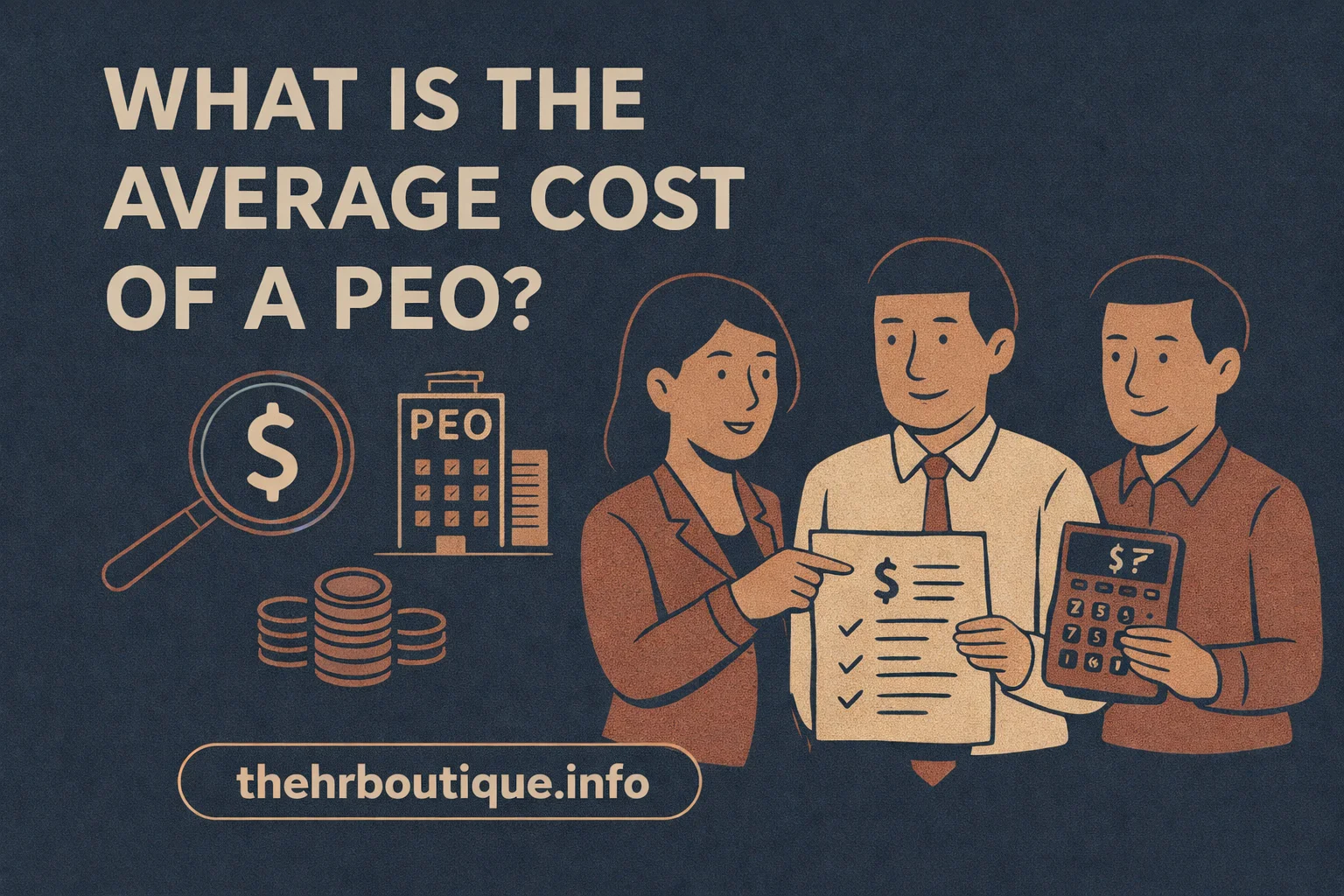
Understanding what a Professional Employer Organization (PEO) will cost your business in 2025 matters because HR outsourcing can save money. Reduce compliance headaches. And free you to focus on strategy rather than paperwork. Many small business owners tell forums they’re frustrated by unclear pricing and hidden fees that suddenly appear after signup.
PEO costs in 2025 typically take three main forms. These are per employee per month (PEPM). A percentage of total payroll. Or hybrid flat fees with per-employee charges. Across providers like TriNet, Justworks, and ADP TotalSource, typical PEPM ranges from roughly $40 to $250 or more. While percentage-based fees usually sit between 2% and 12% of payroll.
The National Association of Professional Employer Organizations (NAPEO) reports the average annual cost around $1,395 per employee, with many companies seeing measurable ROI through lower HR expenses and risk reduction (per industry data).
This can be especially valuable for companies also seeking employee relations service, where legal complexity can amplify risks without proper HR support.
Average PEO Cost Breakdown
| Pricing Model | Typical Cost Range | Best For | What’s Included | Example Providers |
| Per Employee Per Month (PEPM) | $40 – $75 (basic)$150 – $250+ (full-service) | SMBs under 100 employees | Payroll, HR support, benefits administration, compliance (varies by plan) | Justworks ($79), TriNet |
| Percentage of Payroll | 2% – 12% of gross payroll | Larger businesses with variable payroll | Full-service HR, often includes workers’ comp, tax filing, benefits pooling | G&A Partners, ADP TotalSource |
| Flat Fee + Per Employee | $30+ flat fee+ $5–$8 per employee | Startups, solopreneurs | Basic payroll processing, limited HR services | Rippling |
| Hidden Fees | Varies (often $500–$1,000+ setup fees, platform access, or admin charges) | All business sizes | Setup fees, tech platform use, workers’ comp administration | Varies |
PEO Pricing Models Explained
Percent of Payroll Model Details
In this model. A PEO charges a percentage of your total payroll. You’ll often see values between 2% and 12% of wages each pay period. This structure is common for larger firms because it scales with payroll growth.
If your payroll is $100,000 per month and your PEO charges 5%, that’s $5,000 monthly for HR Compliance. And benefits support. This model includes bundled services like workers’ compensation and tax filing. But can spike during bonus periods unless you negotiate clear terms.
Per Employee Per Month
Most small companies prefer the PEPM structure because it lets you predict HR costs as you grow. Typical rates fall between $40 and $250 per employee per month. Often centering around $100–$150 for full-service plans with payroll. Benefits administration. And compliance helps.
Providers like TriNet may estimate pricing in this range. Though custom quotes vary by region and company size. Add-ons such as recruiting or advanced analytics can push the higher end of this range.
Flat Fee Plus Per Employee
Some PEOs offer a flat monthly base fee plus a smaller charge per employee. For example, an entry-level plan might have a $30 base fee plus $5–$8 per employee. Which is an affordable solution for companies just outsourcing payroll while keeping HR oversight internal.
This model is less common but attractive for startups and solopreneur teams that want basic services without a large commitment.
Factors Influencing PEO Cost Variations
Company Size Impact on Pricing
Your headcount significantly influences what you’ll pay. Smaller businesses with fewer than 10 employees tend to see higher per-employee rates because the PEO still provides the same core services but spreads them across fewer people.
As your team grows past 50 or 100 staff, many PEOs offer volume discounts, which can drop effective PEPM costs by $10-$30 per head or lower your percentage of payroll fees. For example the enterprise clients with 500+ employees might negotiate 2–3% of payroll vs 8–10% for under 25 employees.
Larger workforces also benefit more from pooled workers’ compensation rates and group benefits buying power.
Industry Risk and Location Effects
High risk industries like construction or manufacturing often pay 20–30% more in workers’ compensation premiums factored into PEO pricing. The reason is that risk pools charge higher insurance rates.
Multi-state operations or compliance complexity (like California employment law) typically add 10–15% more in administrative fees than single-state businesses with straightforward HR needs. Urban markets with higher average wages. And benefits expenses can also push PEO fees above national averages.
Those in regulated industries often consult an HR counseling service to better understand the compliance risks and pricing tiers associated with their field.
Keeping track of these location and industry factors helps you estimate costs more accurately from your first quote.
Conclusion
The average cost of a PEO in 2025 varies widely based on pricing model. Services selected. Company size and industry. Most companies pay between $40 and $250+ per employee per month or 2% to 12% of payroll. Depending on the provider and scope of services.
If you want to learn more about PEO costs, contact our HR services provider at the HR boutique today.